Tuesday, 7 August 2012

The Sneaker Wall | Dissected

The Nike Air Max 1:


The Nike Dunk:


Vintage Runners:


The Nike Air Max 90:

Tuesday, 31 July 2012

Kicks On Film | Recap

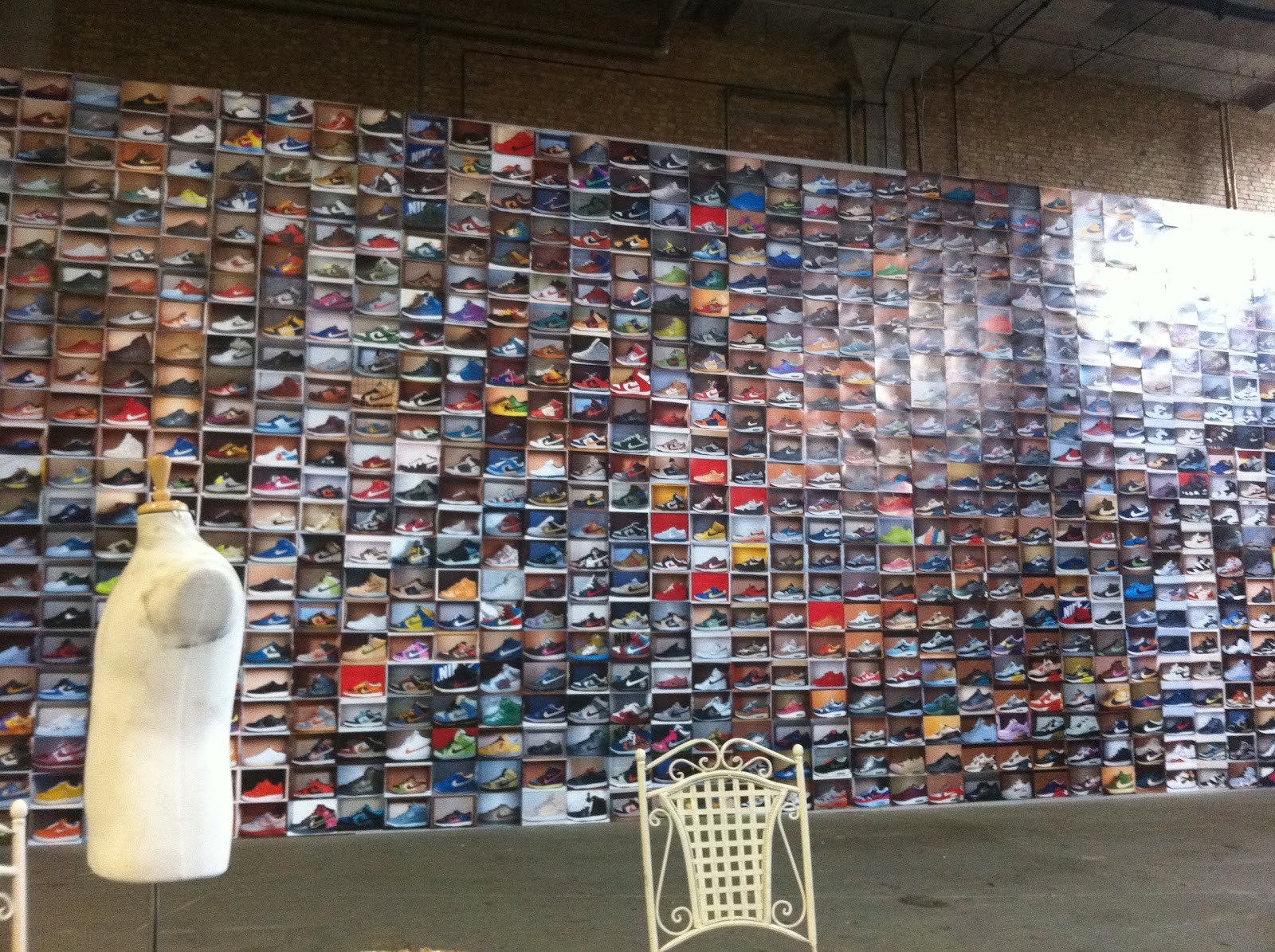
The 29/07/12 saw the opening of pop up exhibition Kicks On Film at V22 in Bermondsey, London. An afternoon and evening based around the screening of a broad selection of sneaker documentaries was supplemented by a sneaker installation comprising of 1500 photographs of sneakers displayed as a single artwork on a wall 15 meters long and 5 meters high. 


Taking its inspiration from Flight Club in New York, the installation was designed to showcase the variety and abundance of Nike models both old and new as well as the rare and historically important. The images (all sourced from Sneakerpedia with no repeats) included portions of famed collections from the likes of DJ Clark Kent, Bobbito Garcia, Grandmaster Caz and Mayor. With such an abundance and diversity of sneakers on display it could have been billed as the perfect collection. With the deliberate incompletion of the last row one was led to believe that there is no such thing as the perfect collection as no collection is ever really complete as long as new sneakers are being made. 
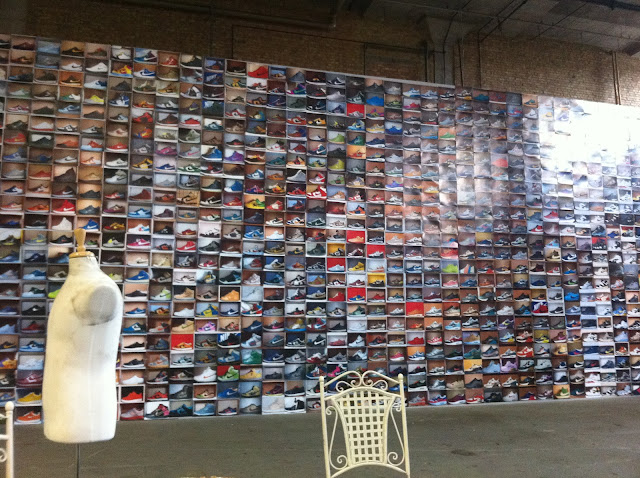

With the closer examination of the wall it became evident that a display of this scale and detail allowed viewers to hunt around for their favourite models and colourways. At times a few felt compelled not just to point at a specific sneaker but take off their own shoes and hold them in the place of the replicated image on the wall. It was hard not to feel the pangs of nostalgia as one would walk up and down the wall reminiscing over the fact that there on the wall was yet another sneaker that had alluded capture in past years. 


Seeing the wall from a distance, it was hard not to feel a complete sense of awe and wonder at the scale of installation. It is one thing to have your neck snapped by a pair of sneakers walking past you in the street, but to  have a sensory overload on this scale, was an experience like no other. At the most basic of levels it was near impossible not to simply stand there and stare minute after minute, allowing one's brain to slowly process all the information picture by picture. If Nike had felt like they had been left out of the London Olympic party with Adidas bagging the sponsorship gig, then this must be considered a fortuitous and brilliant counter punch. 


Sunday, 22 July 2012

SAVE THE DATE!!


KICKS ON FILM proudly presents a cinematic marathon dedicated to sneaker culture and the representation of sneakers on film.

Highlights of the 7 hours of footage will include rare sneaker documentaries and advertising campaigns interspersed with more well know classics and the occasional Michael Jordan highlight reel. Supplementary to the screenings will an installation of 1150 sneaker images ranging from the sublime to the ridiculous including rare treasures from Bobbito Garcia and DJ Clark Kent's collections. 

For more information please hit up twitter @robrobroach

Tuesday, 26 June 2012

Exponential Potential | 3D Printing


3D printing has turned a crucial corner and its true potential is just beginning to be realised. Since the technology was first paraded to the resounding 'oohs' and 'ahhs' of the design world, material science has advanced sufficiently to threaten the more traditional technique of injection molding as being a thing of the past. The upsetting of this balance can be pinpointed to the advent of Multi Material 3D Printing Technology (MM3DPT). Where once you could only print with a specific polymer type (as limited as using only a black ink cartridge in a traditional printer) MM3DPT allows for the combination of different polymers through photopolymerization to create different materials with different properties. In the context of shoe design this allows for the shoe to have a hard sole and flexible upper thus not compromising the comfort and performance of the shoe for the wearer.  


Technicalities aside, I want to discuss the impact that MM3DPT will have on the sneaker community. It is safe to say that sneaker design has been all embracing of new technologies and more often than not has placed itself at the forefront of these innovations. Nike’s Innovation Kitchen should be enough of a prompt to remind us of the relentless pace that new technologies, materials and designs are made commercially available for the sneaker consumer. What has become evident with MM3DPT is that this quick fire method of designing is breaking away from the traditional approach to shoe design. This is by no means a bad thing for the conventional approach begins with hand sketches on paper, which are reviewed and revised several times over until a product concept is approved. The upper materials are then sourced and the concept sent to a shoe factory, taking several weeks for the sample show to arrive. The sample is then reviewed and original sketches once again revised and modified prototypes ordered until the final product design is reached. This is simply not time efficient. The new way would see the initial paper sketch designs moved to 3D CAD software where designs can be manipulated with minimal effort until product managers are happy with the on-screen concept. And then with the simple push of a button a prototype shoe can be quickly printed in the design office, shrinking labour hours significantly. Deconstructing the design process in such a methodical way may seem somewhat futile, but in relation to the sneaker consumer, a quicker design process equates to greater numbers of models, colourways and new designs made available to purchase.  


Having read Brett Golliff’s article on the future implications of Nike’s FlyKnit technology, the development and marketing landscape for sneakers is radically going to change within the next few years. Nike’s material development team has unearthed some extraordinary discoveries in recent memory. Vac Tech, Hyperfuse, Flywire and FlyKnit have made a precedent for the new direction that sneaker design is heading. Construction methods and materials used in the 90’s and mid 2000’s are becoming increasingly obsolete due to the rise in synthetic materials, purpose designed for specific models and releases. But this is not to say that materials like leather and the craftsmanship that is required in making a leather shoe is going to be forgotten. Retro releases, bespoke programes, PE’s and commemorative limited editions are always going to be part of Nike’s makeup and heritage. But rather than producing them as they do today, within the nest 10 years these shoes will become even more of a bespoke and collectible. In the same way that there is a price to be paid for hand made commodities (especially shoes) there will be increased numbers of Nike boutiques, possibly modeled on the likes of 21 Mercer St in New York, acting as skilled cobblers ready to make on demand the historic sneakers of yester year. 


So we have sneaker consumption and production heading in two ways. Option one, will see home printing allowing for the latest up to date performance and innovation based designs to be downloaded off the internet and tailored to your exact foot measurements. This will be possible with the a 3D-scanner that will be complimentary when purchasing a 3D printer. Also sites like Pirate Bay will enable the downloading of "physibles" where people can share and download schematics for 3D printable objects. Option two is for you to go to your nearest Nike boutique and order your own tailored Jordan Retros where they will craft them for you out of the best quality materials but at a price that reflects the quality of the shoe. That is something that Jordan footwear is not abiding by today. If this is the immediate future, then it is a bright bright future indeed. 

Wednesday, 30 May 2012

Digital vs Analogue


Nike’s big reveal of their Air Force One ‘High Frequency Digital Camouflage’ is a clear cut reminder that their aesthetics committee is willing to test new waters. Like the Nike Foamposite Galaxy and Tom Sachs x Nike Craft: Space Camp Project, the HFDC is deeply rooted in Nike’s burgeoning conceptual portfolio. It feels indebted to the groundwork laid by independent design projects, in particular Matt Stevens’ Max 100. Despite his conceptual designs appearing on Nike Air Max 1’s, similarities to the HFDC are easy to spot when comparing it to the Returned, Logical, Puzzled and Equal prints. This is by no means a negative observation. On the contrary it proves that Nike are not just willing to support artistic collaborations but more importantly try to play the game themselves.

It is increasingly feasible that Nike will be releasing a commemorative AF1 pack for each of the AF1’s 30 years of existence by the end of this year. If true, time dictates that there will be a flurry of new AF1’s in the coming months fuelling much speculation over Nike’s every creative step. With speculation, however, there always needs to be clear differentiation between what is probable and what the consumer desires.  The following ideas certainly reflect the latter. 

Continuing with the principal theme of camouflage it would be interesting to see how Nike would approach creating a sister pack to the HFDC by basing the aesthetic on analogue not digital image making. Having a digital vs. analogue aesthetic is a jovial reinterpretation of the classic battle between old and new. Nike has been scripting this narrative for some time with their integration of the latest technologies and design elements onto their classic silhouettes. The challenge set with the analogue pack is it’s not just enough for the innovation to be the hyperfusing, Vach Tech or using of FreeSole, but in creating a dated visual affect using these modern of modern methods. To understand the extent of this problem here are some images of analogue interference that would best suit the camouflage theme. 


Importantly, Nike can draw inspiration from elsewhere too. Attempting to imitate the images above onto fabric pixel-by-pixel runs the risk of loosing the original effect altogether. The differences in material property between electronic images and fabric designs are not only numerous but also hugely complex. The differences between graphic design and fabric design however are concretely more similar. The work of Op artist Bridget Riley is a case in point. Although she investigates many areas of perception, her work, with its emphasis on optical effects is the perfect bridge between electronic images and fabric design. As she explains in this video about her working methods, she emphasises the importance of repetition of pattern to create an overall effect and not the repetition of singular cells or pixels.  


IMAGES OF HER WORK:


If Nike were to create something along the lines of what has been speculated here, it would be first and foremost a triumph of cerebral design but more importantly a reinforcing of Nike’s increasing success at bridging the world of art and artist with the world of commercial and consumer driven design.