Showing posts with label Sneaker Customisation. Show all posts

Thursday, 11 October 2012

Nike SPD | Dan Mather


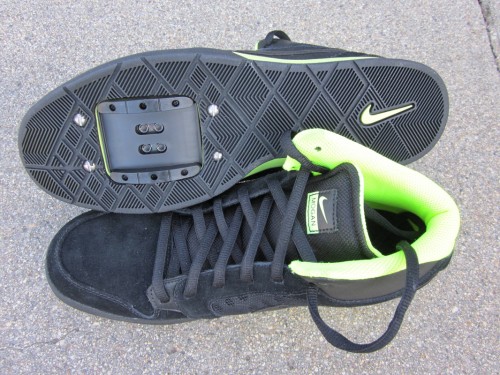
Out of the 78 creatives chosen to challenge the function of Nike shoes in the Nike 78 project, Dan Mather's attempt to transform a pair of Nike sneakers into cycling shoes may have the greatest repercussions for the sneaker community.  As he rightly states, "cycling shoes are generally designed with one purpose in mind; for transferring power from your foot to the pedal, with most efficiency". Naturally, the balance between aesthetic and function is ignored. For the recreational cyclist who may prefer to priorities aesthetics over function, is currently forced to cycle with a traditional pedal kept either open or to increase performance, worn with clips and straps. In the later set up the shoe is subject to wear, damage and eventual deterioration. This is a dilemma that faces any sneaker enthusiast with a disposition for cycling. Carrying a spare pair may seem like an obvious answer but given the frequency of rides one would have yearly, the impracticality of carrying a spare pair and having to change footwear becomes apparent. So Mather's proposal of marrying a bicycle shoe and a sneaker together is not such a bad idea. To quote him directly again, "Nike shoes are ubiquitous with fashion and popular culture irrespective of sport, so I have transformed my Nikes into a pair of cycling shoes that strike the balance between function and aesthetics, creating a pair of functional, yet desirable sneakers you can wear both on and off the bike".  


Judging from the pictures alone, the finished product is not quite there. The profile of the plate and clip still protrudes too much from the sole of the Waffle Racer. The problem is only compounded further by the clip failing to be of equal measurement to the protrusion of the pimples on the sole. If the shoe was to work as a true hybrid the plate and clip would need to be set deeper into the sole in order accommodate the wearing down of the pimples when walking for an extended period of time. A good example of how the concept might have been executed better is like the image below. 

The exact working methods of Dam Mather are unknown but I will attempt to explain how a better finish could be achieved. 

Firstly the choice of shoe is important for it's integral to avoid the cleat ripping out of the sole from the sheer volume of power transferred between your foot and the pedal. A general rule of thumb is any sneaker with a polyerethane base instead of the regular EVA foam is best as under extreme pressure it doesn't compress as easily. Also Nike Air Zoom technology is a safe bet because the air in the Zoom unit(s) is pressurized, while the regular non-zoom air units are not. If that is all too much to remember the thicker the sole unit the better. The Nike Air Force 1 should be the benchmark. 


Now for the technical details as supplied by Retrofitz:


Parts:

1) 2 injection molded impact modified nylon plates
2) 2 injection molded Shore 85A TPU rubber bumper
3) 8 stainless steel binding post and screw


Cut placement:

4) Placement of the thru hole dictates cleat placement


Recommended tools:


- steel rule die
- drill alignment fixture with custom 3/8” thick UHMW cutting board
- 3/8” thick UHMW cutting board
- custom ground step drill 0.090”/.1875” with stop gauge
- shoe sole thickness gauge 
- 4 Ton arbor press
- aviator snips 
- standard screwdriver 
- metric ruler
- marking pen 
- 1-1/2” wide painters masking tape
- 1/2” wide painters masking tape
- drill press or handheld drill 
- 1/8” diameter 4-flute end cutting end mill
- hacksaw 
- paper
- large calipers


Important facts to check about the sneakers:

5) SPD cleats will not properly engage pedal if shoe sole (in the area where the cleat will be located) is greater than 10mm thick. 
6) If shoe liners are permanently glued into place and cannot be removed, the shoes may not be suitable. 

Next steps:

7) Remove shoe laces and shoe liners
8) Layout the thru cut lines on the bottom of the shoe
9) The cut should be parallel with the shoe centerline
10) The cut should penetrate the sole only, not the side panels of the shoe
11) The cut must be placed with consideration for the four threaded fasteners that will hold the cut into place
12) The inside edge of the cut must be X Dimension = 22mm or less from the widest part of the shoe, this provides 5mm of clearance between the shoe and the pedal. 
13) The Y dimension is subject to disgression:
                    - plate placement: insure the mounting holes will penetrate the sole appropriately
                    - rider preference: cleat placement has a large influence on power transfer
and riding efficiency
                    - in general the centerline of the cleat should fall somewhere behind the ball of the foot where possible


14) Confirm cut lines will appropriately penetrate shoe interior and shoe sole
15) Some shoes have very narrow toe boxes and the die will have to be carefully plaveed to insure the hole is located appropriately
16) Use large calipers to visualize where the die will penetrate the shoe interior
17) Make adjustments to the cut location as necessary to avoid cutting thru shoe sides
18) Maintain the X=22mm maximum
19) Measure twice, cut once!
20) Prepare UHMW cutting board, insert inside shoe opposite steel rule
21) Use a removed liner to trace and cut the profile on 0.25" thick UHMW cutting board
22) The steel rule die will lightly cut the into the UHMW cutting board 
23) The UHMW cutting board protects the interior of the shoe from being cut by the die


24) Secure steel rule die to shoe
25) Align die edges with tape
26) Use 1.5" wide tape to secure the shoe
27) Use generous amount of tape to wrap around top of shoe
28) Confirm die is aligned with the centerline of the shoe
29) Measure twice, cut once!


30) Cut hole 
31) Repeat previous steps for shoe 2
32) Confirm the steel rule die is placed in the same place on the right shoe as on the left
33) It is mandatory that the cuts are accurately "mirrored" to the opposite shoe for proper cleat alignment
34) Measure twice, cut once!


35) Insert hole boring to shoe
36) Insure the UHMW cutting board is cut to fit inside shoe interior woth room to spare, otherwise it may cause the fixture to twist and be mis-aligned relative to the cut hole


37) Bore 1/8" holes thru shoe sole using the 1/8" four flute cutting endmill 
38) Counter bore the four holes
39) Repeat these steps for other shoe
40) Trim nylon plates to fit inside shoes
41) Make paper cutout of shoe interior using removed liners
42) Trace cute opening onto paper cutout
43) Align paper cutout onto nylon plates with opening aligned to the plate details
44) Transfer outline of shoe interior onto nylon plates using paper cutout template


45) Trim the nylon plate to fit inside the opposite shoe
46) Assemble nylon plates to shoes 
47) Use stainless steel binding head fasteners provided


48) Assemble 4 hole threaded plate to both shoes
49) Insert shoe liners
50) Re-lace shoes 

Wednesday, 26 September 2012

Collaborations | Where to next for Nike?


It has been a decade since Nike first explored the potential of reworking their classic silhouettes by inviting artists to freelance with them on a specific sneaker. The "sneakerhead" culture of the early 2000's would dictate the direction that Nike would take when selecting their artist. With Michael Jordan in his swansong, it was the first time that the attraction of indie art and the exclusivity surrounding it was made commercially available. The creation of sneaker boutiques embodied and empowered this new scene. For Nike to make a success of this new and previously closed world, an artist series release was conceived with Brooklyn-native Josh Franklin a.k.a Stash. The rest is history. Many may remember Stash's Nike Air Classic BW, with a release limited to 1000 individually numbered pairs but it was just a single step in a legacy defining series. The Air Force 1 High and Mid were not exempt from a radical re-hauling and nor was the Air Force 1 low and Air Max 95 that constituted the infamous Blue Pack of 2003. But it was no fairytale ending for Stash and his collaboration with Nike. In recent history the relationship between the two has been askew and ultimately soured. Some feel that it's a bit ridiculous, especially considering Nike took Stash from an underground pioneer to a household name. It also must be remembered that Stash, through his revitalizing of old classics with visionary touches of flair, may have proved to Nike that it's the collaborator who truly makes the shoes. Inevitably its hard not to hold the opinion that Stash saw himself and his name to be more important than the artistic creation and its canvass. Naturally you may understand how this might not have sat well with Nike, for nothing is bigger and more important than the Nike Swoosh and the sneaker that it's on.
 
I so return to my original question. Where does that leave us now? Ostensibly the template has not drastically changed. Nike has since courted many of the worlds best underground and street artists post 2002 who have all tried to emulate the success of Stash, for better or for worse. For those less familiar with who these artists may be here is a selected few:

Unkle/Futura 2000  
Hiroshi Fujiwara 
Skulls of Saigon
Ketsuya Terada 
Claw Money
Gasius
 Haze


These and many more artists like them will be continually approached by Nike for years to come. What all of them have proved is there's an insatiable hunger in the sneaker community for these products. They not only respect these collaborations for successfully combining multiple aspects of street culture, but for this exact reason the collaborations act as an important documentation of the ever changing face of street culture. As Nike knows all too well, this is what people are desperate to be a part of by having to buy a part of it before it disappears and exists only in memory.

For the foreseeable future, this is an unchanging formula for Nike. it's been tried and tested for a decade and is showing no signs of loosing any of the excitement, hype and desire that was first generated by Stash's legacy defining shoes. Baring this in mind, Nike are not finished experimenting with the subject of art and artists. The Tom Sachs Mars Space Program with the Nike Mars Yard Shoe is a case in point. Much of the DNA is the same - a release number of a couple of hundred, use of bespoke materials and innovative design techniques as well as the successful marriage of brand identity with the artist's signature style. The difference is in the story of the shoe. No longer is it an older model getting another facelift but an entirely new creation, purpose built by the artist as an artistic extension of his practice and ideology. The consumers' needs are trivial. This is a hugely conceptual leap for what on the face of things is an all singing all dancing sports company. Or is it? 

The tone of the Mars Yard shoe has shifted. It would seem nearer to being a bonafide art work than any Nike creation to this date. That's not from its appearance but from its purpose in the conceptual installation and performance of Tom Sachs' artwork. However, even though the appearance of the shoe is radically different from past Nike models, its functionally exactly the same. It's still a fully functional shoe. The fact that 200 pairs were made commercially available encouraged the consumer to buy into the product in an attempt to try to buy into the artwork itself.  The reality was by buying a pair, you were buying a replica of the artwork rather than the genuine article. You were buying into the idea that with these shoes you too would be able to discover, mimic and experience what Tom Sachs' Mars Space Program was actually like. If all of a sudden this seems surprisingly similar then this might be why:


All that has happened is Nike are replacing the sporting achievements of a global sports star with the artistic achievements of a world famous artist. Both feats are unachievable by the average person on the street but they may get a bit closer to achieving such greatness by buying the respective shoes. It is nothing short of genius.

This recycling and disguising of past ideas doesn't have to be limited to Nike's own. In 1975 Hervé Poulain invited his friend Alexander Calder to design a car that married artistic excellence to 'an already perfect object' creating what would be the first of a prestigious collection of BMW Art Cars. Since then some of the greatest names in contemporary art have added to the collection creating a wide range of artistic interpretations. 


Before you cry out in dismay saying this is exactly what Nike have already done with their artist series, you are not entirely wrong. However, what this also represents is the means by which Nike can increase its share in a market previously closed to it. Keeping an open mind, there is only one significant difference between a BMW car and an AF1 - it's cost. Other than that they are remarkably similar. They are both highly functional. They are already the perfect object, a design classic. In fact the designing of shoes and cars are virtually the same. The design is never radically re-hauled and reinvented but simply tailored and tweaked to get that increased bit of performance. After all the AF1 is unchanged for 30 years and can still perform with the best of today's offering on the hardwood courts of NBA arenas. The same can be said with BMW's M series'. Cosmetic changes over the years have reflected the changes in taste and fashion but underneath the bonnet and bodywork its still the same mechanics and construction.  

As the price would suggest, a BMW car is a luxury item. In stating the obvious, Nike has yet to break into this luxury market. But if it were, it doesn't have to do so by matching the BMW in charging astronomical prices, it rather has to prove to the luxury market that the AF1 is perfect. Perfection or accredited perfection is what drives the luxury market. Even in our economically difficult times, the only bubble not to completely burst is the art bubble. All Nike need to do is get Yayoi Kusama, Daniel Buren, Hans Haake, Chris Ofili or any of the YBA's (the list is endless) to do to the AF1 what a previous generation of artists have done to the BMW art car. Arguably there isn't a better seal of grandeur, decadence and achievement to have a universally acclaimed artist pay homage to a design by decorating in whatever way they deem fit.

Contrary to the eclectic names of artists suggested for Nike to collaborate with, a little more care and thought would be needed in successfully matching artist with medium. What little brief there might be for such a collaboration would simply enforce the AF1 to remain true to its original design in that it would still have to function as a shoe. The likes of Hans Haacke would be more suited to the artistic challenges of projects such as this - http://www.nike78.co.uk/. In the name of an artist series this is by far the greatest and most dangerous step that Nike have made yet. All their previous methods for collaboration have never allowed for the object desire and functionality of the shoe to be lost. Nike 78 is taking shoes into a realm that the majority of Nike faithfuls may not desire to go. The shoe has finally become something unrecognizable. It has been made impotent for functioning in the real world. It has become the subject and property of art and art alone. Nike have truly embarked upon exploring the new world.

Tuesday, 14 August 2012

Green Eyed Envy

“If the shoe fits in with other things that are going on culturally, you get a perfect storm.”
Tinker Hatfield


“There was no brief — it was pure experimentation.”
Eric Avar


"We were setting out to create a seamless extension of your body.”
Eric Avar


“You learn from every project that you do, but I can’t think of many other projects where we learned so much.”
Tracy Teague


“We’re always trying to evolve platforms and technologies — can we make it more responsive, lighter, more natural motion? There is no finish line.”
Eric Avar

Tuesday, 26 June 2012

Exponential Potential | 3D Printing


3D printing has turned a crucial corner and its true potential is just beginning to be realised. Since the technology was first paraded to the resounding 'oohs' and 'ahhs' of the design world, material science has advanced sufficiently to threaten the more traditional technique of injection molding as being a thing of the past. The upsetting of this balance can be pinpointed to the advent of Multi Material 3D Printing Technology (MM3DPT). Where once you could only print with a specific polymer type (as limited as using only a black ink cartridge in a traditional printer) MM3DPT allows for the combination of different polymers through photopolymerization to create different materials with different properties. In the context of shoe design this allows for the shoe to have a hard sole and flexible upper thus not compromising the comfort and performance of the shoe for the wearer.  


Technicalities aside, I want to discuss the impact that MM3DPT will have on the sneaker community. It is safe to say that sneaker design has been all embracing of new technologies and more often than not has placed itself at the forefront of these innovations. Nike’s Innovation Kitchen should be enough of a prompt to remind us of the relentless pace that new technologies, materials and designs are made commercially available for the sneaker consumer. What has become evident with MM3DPT is that this quick fire method of designing is breaking away from the traditional approach to shoe design. This is by no means a bad thing for the conventional approach begins with hand sketches on paper, which are reviewed and revised several times over until a product concept is approved. The upper materials are then sourced and the concept sent to a shoe factory, taking several weeks for the sample show to arrive. The sample is then reviewed and original sketches once again revised and modified prototypes ordered until the final product design is reached. This is simply not time efficient. The new way would see the initial paper sketch designs moved to 3D CAD software where designs can be manipulated with minimal effort until product managers are happy with the on-screen concept. And then with the simple push of a button a prototype shoe can be quickly printed in the design office, shrinking labour hours significantly. Deconstructing the design process in such a methodical way may seem somewhat futile, but in relation to the sneaker consumer, a quicker design process equates to greater numbers of models, colourways and new designs made available to purchase.  


Having read Brett Golliff’s article on the future implications of Nike’s FlyKnit technology, the development and marketing landscape for sneakers is radically going to change within the next few years. Nike’s material development team has unearthed some extraordinary discoveries in recent memory. Vac Tech, Hyperfuse, Flywire and FlyKnit have made a precedent for the new direction that sneaker design is heading. Construction methods and materials used in the 90’s and mid 2000’s are becoming increasingly obsolete due to the rise in synthetic materials, purpose designed for specific models and releases. But this is not to say that materials like leather and the craftsmanship that is required in making a leather shoe is going to be forgotten. Retro releases, bespoke programes, PE’s and commemorative limited editions are always going to be part of Nike’s makeup and heritage. But rather than producing them as they do today, within the nest 10 years these shoes will become even more of a bespoke and collectible. In the same way that there is a price to be paid for hand made commodities (especially shoes) there will be increased numbers of Nike boutiques, possibly modeled on the likes of 21 Mercer St in New York, acting as skilled cobblers ready to make on demand the historic sneakers of yester year. 


So we have sneaker consumption and production heading in two ways. Option one, will see home printing allowing for the latest up to date performance and innovation based designs to be downloaded off the internet and tailored to your exact foot measurements. This will be possible with the a 3D-scanner that will be complimentary when purchasing a 3D printer. Also sites like Pirate Bay will enable the downloading of "physibles" where people can share and download schematics for 3D printable objects. Option two is for you to go to your nearest Nike boutique and order your own tailored Jordan Retros where they will craft them for you out of the best quality materials but at a price that reflects the quality of the shoe. That is something that Jordan footwear is not abiding by today. If this is the immediate future, then it is a bright bright future indeed. 

Wednesday, 30 May 2012

Digital vs Analogue


Nike’s big reveal of their Air Force One ‘High Frequency Digital Camouflage’ is a clear cut reminder that their aesthetics committee is willing to test new waters. Like the Nike Foamposite Galaxy and Tom Sachs x Nike Craft: Space Camp Project, the HFDC is deeply rooted in Nike’s burgeoning conceptual portfolio. It feels indebted to the groundwork laid by independent design projects, in particular Matt Stevens’ Max 100. Despite his conceptual designs appearing on Nike Air Max 1’s, similarities to the HFDC are easy to spot when comparing it to the Returned, Logical, Puzzled and Equal prints. This is by no means a negative observation. On the contrary it proves that Nike are not just willing to support artistic collaborations but more importantly try to play the game themselves.

It is increasingly feasible that Nike will be releasing a commemorative AF1 pack for each of the AF1’s 30 years of existence by the end of this year. If true, time dictates that there will be a flurry of new AF1’s in the coming months fuelling much speculation over Nike’s every creative step. With speculation, however, there always needs to be clear differentiation between what is probable and what the consumer desires.  The following ideas certainly reflect the latter. 

Continuing with the principal theme of camouflage it would be interesting to see how Nike would approach creating a sister pack to the HFDC by basing the aesthetic on analogue not digital image making. Having a digital vs. analogue aesthetic is a jovial reinterpretation of the classic battle between old and new. Nike has been scripting this narrative for some time with their integration of the latest technologies and design elements onto their classic silhouettes. The challenge set with the analogue pack is it’s not just enough for the innovation to be the hyperfusing, Vach Tech or using of FreeSole, but in creating a dated visual affect using these modern of modern methods. To understand the extent of this problem here are some images of analogue interference that would best suit the camouflage theme. 


Importantly, Nike can draw inspiration from elsewhere too. Attempting to imitate the images above onto fabric pixel-by-pixel runs the risk of loosing the original effect altogether. The differences in material property between electronic images and fabric designs are not only numerous but also hugely complex. The differences between graphic design and fabric design however are concretely more similar. The work of Op artist Bridget Riley is a case in point. Although she investigates many areas of perception, her work, with its emphasis on optical effects is the perfect bridge between electronic images and fabric design. As she explains in this video about her working methods, she emphasises the importance of repetition of pattern to create an overall effect and not the repetition of singular cells or pixels.  


IMAGES OF HER WORK:


If Nike were to create something along the lines of what has been speculated here, it would be first and foremost a triumph of cerebral design but more importantly a reinforcing of Nike’s increasing success at bridging the world of art and artist with the world of commercial and consumer driven design.