Showing posts with label Sneaker News. Show all posts

Wednesday, 19 December 2012

Fusions & Hybrids | Hero or Villain

Can you name all the sneakers bastardised in this fusion nightmare?

It has now been two weeks since Tinker Hatfield and Josh Heard unveiled the #AirJordanXX8. The shockwaves have passed and the dust settled again allowing the sneaker community to return to its accustomed sense of normality. So the time seems more than right to objectively review the impact that this shoe has had. 

On the face of things it has professedly been a long time since Nike and more specifically Air Jordan have so energetically developed and hyped a basketball concept shoe. Wether this is down to the power of Michael Jordan's persona or the the strength of the brand, the one message for the us to take home is the Jordan Brand are at last making an asserted push for new technologies and new levels of performance in their footwear to match their continued reinventing of the basketball aesthetic. But just before there is a huge sigh of relief I feel the urge to play devil's advocate and challenge the majority consensus. Is the Air Jordan XX8 not just a glorified #NikeZoomFlight98 (aka The Glove) or some hi tech fusions? Is it really something revolutionary or not simply the recycling of past ideas or worse still the ideas of market competitors?


The reason that these questions are so easy to ask is that the visual similarities to past sneakers is so strong.  You could easily be mistaken to believe that the XX8 is in fact the eight or ninth generation version of the original ZF 98. On paper this should not cause problems but because this latest offering has been marketed as the future of basketball footwear, it has not delivered the aesthetic impact that is fit for such an introduction. There is a huge gulf in the complexity of the performance technology built into the shoe and its overall appearance.  This is disappointing because #Nike has wowed its consumer fan base with this same silhouette back in 1998 with the ZF 98. They could have simply retro-ed the originals (as promised for this year) allowing them the freedom to create something genuinely new and exciting rather than a shoe who's identity is slowly being tarnished by the talk of being a fusion. Like the clever fusions of the past (AJF3 and AJF5) the XX8 has incorporated a deceptive design that draws attention from the fusion aspect and centres on over accentuation the core classic design that is the sheathing of the inner shoe first used on the ZF98. If you are like me and catch yourself reacting to the aesthetics in such a way why would you not just buy the original, which is what we were sweating over as kids to begin with and still truly want? In truth Nike could have played things better. 

Now for the second part. If you are someone who rigorously wades through all the promotional material released by Nike in the wake of a new shoe then you would have inevitably come across the interviews with Tinker and Josh. Aside from the joy to be had from designers lifting the lid on their creations, what their creative thought process has revealed is how murky the world of intellectual property is. This sentiment is inevitably heightened since the on suing of FlyKnit-gate but there still seems to be a couple of things to worry about. There was continuous mentioning of the design process being led by the image of a sprint spike for basketball players. If 
#Adidas were feeling bullish there would seem to be enough evidence to start locking legal horns with Nike once again but personally on these grounds alone to me there just is insufficient evidence. There's no denying Adidas were per suing the same performance goals with the Derick Rose line but Nike have a long track record of historically developing their footwear in this direction. If history relates then most recently it was the Air Jordan 2009 that was the most recent shoe to be influenced by sprinting as well. After all Nike signed April Holmes and her prosthetic leg inspired the hell of the 2009. But just to make things more complicated, the Adidas Supernatural Creator came out around 2009 and is arguably exactly the same as the Jordan but with just a bigger bootie. 

What is more interesting is the similarities in the construction of the sole units shared by the XX8 and the Adidas Puremotion golf shoe. Aesthetic similarities are the first pointer. The technological similarities the second. You just have to have a close look at the XX8's midsole and flight plate to get a sense of where this comparison is coming from. Where the crucial difference might just be is that judging by the full view of the outsole, the midsole and flight plate aren't popular like the Puremotion. This all may sound overly technical but to wrap things up I'll let you decide with a good old fashioned exercise in compare and contrast below.          


Tuesday, 20 November 2012

Designer Database | Tate Kuerbis

Tate Kuerbis is another designer who's work we need to start associating with his name more often. His career with Nike has seen him rise through the ranks from just a junior designer for Air Jordan to a head designer and eventually a senior footwear designer for the brand. Unlike many designers that will be featured in this database, Tate Kuerbis is in the special bracket of designers that have designed shoes for differing sports. In Keurbis's case his portfolio is heavy with basketball models but includes a selection of tennis models. For those less familiar with his name and work please scroll through the images below. 

As with all these lists they are not complete and will be continually updated once more patents have been looked at. 


Air Jordan XVIII:


Air Jordan XIX:


Nike Air Dozer Force:


Air Jordan Team 1:


Jordan 12.5:


Nike Uptempo Pro:


Nike Vapor IV (tennis):


Sneakers that I couldn't find the images for include:

- Nike Zoom Max Uptempo
- Nike Zoom Flight 98

Thursday, 25 October 2012

The AlphaProject | Jason Petrie

Many of you will know of his story already...
 
Jason Petrie is a sneaker designer who once plied his trade for Fila before realising his true potential at Nike. If you frequently trawl the archives, forums and trending discussions on NikeTalk, at some point you'll have come across Jason Petrie's written and pictorial contributions. He is a designer that for years has quietly continued to wow us and and give us aesthetically pleasing, forward thinking performance products with his own signature flair. I would happily tip him to eventually achieve the profile that Aaron Cooper or Eric Avar have managed during their careers. This may be a highly subjective sentiment but if you were in any doubt let these images persuade you otherwise. 


Sunday, 22 July 2012

SAVE THE DATE!!


KICKS ON FILM proudly presents a cinematic marathon dedicated to sneaker culture and the representation of sneakers on film.

Highlights of the 7 hours of footage will include rare sneaker documentaries and advertising campaigns interspersed with more well know classics and the occasional Michael Jordan highlight reel. Supplementary to the screenings will an installation of 1150 sneaker images ranging from the sublime to the ridiculous including rare treasures from Bobbito Garcia and DJ Clark Kent's collections. 

For more information please hit up twitter @robrobroach

Tuesday, 26 June 2012

Exponential Potential | 3D Printing


3D printing has turned a crucial corner and its true potential is just beginning to be realised. Since the technology was first paraded to the resounding 'oohs' and 'ahhs' of the design world, material science has advanced sufficiently to threaten the more traditional technique of injection molding as being a thing of the past. The upsetting of this balance can be pinpointed to the advent of Multi Material 3D Printing Technology (MM3DPT). Where once you could only print with a specific polymer type (as limited as using only a black ink cartridge in a traditional printer) MM3DPT allows for the combination of different polymers through photopolymerization to create different materials with different properties. In the context of shoe design this allows for the shoe to have a hard sole and flexible upper thus not compromising the comfort and performance of the shoe for the wearer.  


Technicalities aside, I want to discuss the impact that MM3DPT will have on the sneaker community. It is safe to say that sneaker design has been all embracing of new technologies and more often than not has placed itself at the forefront of these innovations. Nike’s Innovation Kitchen should be enough of a prompt to remind us of the relentless pace that new technologies, materials and designs are made commercially available for the sneaker consumer. What has become evident with MM3DPT is that this quick fire method of designing is breaking away from the traditional approach to shoe design. This is by no means a bad thing for the conventional approach begins with hand sketches on paper, which are reviewed and revised several times over until a product concept is approved. The upper materials are then sourced and the concept sent to a shoe factory, taking several weeks for the sample show to arrive. The sample is then reviewed and original sketches once again revised and modified prototypes ordered until the final product design is reached. This is simply not time efficient. The new way would see the initial paper sketch designs moved to 3D CAD software where designs can be manipulated with minimal effort until product managers are happy with the on-screen concept. And then with the simple push of a button a prototype shoe can be quickly printed in the design office, shrinking labour hours significantly. Deconstructing the design process in such a methodical way may seem somewhat futile, but in relation to the sneaker consumer, a quicker design process equates to greater numbers of models, colourways and new designs made available to purchase.  


Having read Brett Golliff’s article on the future implications of Nike’s FlyKnit technology, the development and marketing landscape for sneakers is radically going to change within the next few years. Nike’s material development team has unearthed some extraordinary discoveries in recent memory. Vac Tech, Hyperfuse, Flywire and FlyKnit have made a precedent for the new direction that sneaker design is heading. Construction methods and materials used in the 90’s and mid 2000’s are becoming increasingly obsolete due to the rise in synthetic materials, purpose designed for specific models and releases. But this is not to say that materials like leather and the craftsmanship that is required in making a leather shoe is going to be forgotten. Retro releases, bespoke programes, PE’s and commemorative limited editions are always going to be part of Nike’s makeup and heritage. But rather than producing them as they do today, within the nest 10 years these shoes will become even more of a bespoke and collectible. In the same way that there is a price to be paid for hand made commodities (especially shoes) there will be increased numbers of Nike boutiques, possibly modeled on the likes of 21 Mercer St in New York, acting as skilled cobblers ready to make on demand the historic sneakers of yester year. 


So we have sneaker consumption and production heading in two ways. Option one, will see home printing allowing for the latest up to date performance and innovation based designs to be downloaded off the internet and tailored to your exact foot measurements. This will be possible with the a 3D-scanner that will be complimentary when purchasing a 3D printer. Also sites like Pirate Bay will enable the downloading of "physibles" where people can share and download schematics for 3D printable objects. Option two is for you to go to your nearest Nike boutique and order your own tailored Jordan Retros where they will craft them for you out of the best quality materials but at a price that reflects the quality of the shoe. That is something that Jordan footwear is not abiding by today. If this is the immediate future, then it is a bright bright future indeed. 

Wednesday, 30 May 2012

Digital vs Analogue


Nike’s big reveal of their Air Force One ‘High Frequency Digital Camouflage’ is a clear cut reminder that their aesthetics committee is willing to test new waters. Like the Nike Foamposite Galaxy and Tom Sachs x Nike Craft: Space Camp Project, the HFDC is deeply rooted in Nike’s burgeoning conceptual portfolio. It feels indebted to the groundwork laid by independent design projects, in particular Matt Stevens’ Max 100. Despite his conceptual designs appearing on Nike Air Max 1’s, similarities to the HFDC are easy to spot when comparing it to the Returned, Logical, Puzzled and Equal prints. This is by no means a negative observation. On the contrary it proves that Nike are not just willing to support artistic collaborations but more importantly try to play the game themselves.

It is increasingly feasible that Nike will be releasing a commemorative AF1 pack for each of the AF1’s 30 years of existence by the end of this year. If true, time dictates that there will be a flurry of new AF1’s in the coming months fuelling much speculation over Nike’s every creative step. With speculation, however, there always needs to be clear differentiation between what is probable and what the consumer desires.  The following ideas certainly reflect the latter. 

Continuing with the principal theme of camouflage it would be interesting to see how Nike would approach creating a sister pack to the HFDC by basing the aesthetic on analogue not digital image making. Having a digital vs. analogue aesthetic is a jovial reinterpretation of the classic battle between old and new. Nike has been scripting this narrative for some time with their integration of the latest technologies and design elements onto their classic silhouettes. The challenge set with the analogue pack is it’s not just enough for the innovation to be the hyperfusing, Vach Tech or using of FreeSole, but in creating a dated visual affect using these modern of modern methods. To understand the extent of this problem here are some images of analogue interference that would best suit the camouflage theme. 


Importantly, Nike can draw inspiration from elsewhere too. Attempting to imitate the images above onto fabric pixel-by-pixel runs the risk of loosing the original effect altogether. The differences in material property between electronic images and fabric designs are not only numerous but also hugely complex. The differences between graphic design and fabric design however are concretely more similar. The work of Op artist Bridget Riley is a case in point. Although she investigates many areas of perception, her work, with its emphasis on optical effects is the perfect bridge between electronic images and fabric design. As she explains in this video about her working methods, she emphasises the importance of repetition of pattern to create an overall effect and not the repetition of singular cells or pixels.  


IMAGES OF HER WORK:


If Nike were to create something along the lines of what has been speculated here, it would be first and foremost a triumph of cerebral design but more importantly a reinforcing of Nike’s increasing success at bridging the world of art and artist with the world of commercial and consumer driven design.  

Friday, 18 May 2012

Nike Craft | Blank Canvas


For some time now Nike have experimented with traditional craft techniques in developing new lines of sneakers. Based on the number of existing models, weaving and knitting have proved to be the two crafts most accommodating of the design requirements set by Nike. The success of the Nike Air Woven, Nike Lunar Chukka Woven, Nike Air Presto Woven, Nike Air Footscape and Nike FlyKnit is that the techniques of weaving and knitting are still congruous with the increasing array of performance based synthetic materials available to Nike’s disposal.

Nike’s adoption of weaving and knitting is not simply performance led. There is also a strong aesthetic incentive. Utilising techniques that integrate different strands of material in a variety of colours and capable of forming innumerable patterns and textures opens up a vast number of aesthetic choices. In truth, Nike has not experimented incongruously with the possibilities on offer. The most enterprising that they have been is with the Nike Air Footscape or Nike Lunar Chukka Woven. The Air Footscape is probably the more adventurous of the two. It’s woven seam running along the outside of the shoe defines it’s strong aesthetic, in ways similar to the Frankenstein monster. The colour combinations, however, serve as merely decorative distraction to the focal point that is the architectural and textural seam. The Lunar Chukka Woven Multicolour, though less adventurous in design, is principally a study of colour. However, due to the simplistic geometric design of the weave, the colours remain eye catching but the composition remains simplistic and very flat. If Nike is not keen to experiment with different techniques of weaving and knitting to bring an aesthetic complexity and interest to some of their models, it may be in their interest to experiment with similar crafts, in particular Needlepoint.

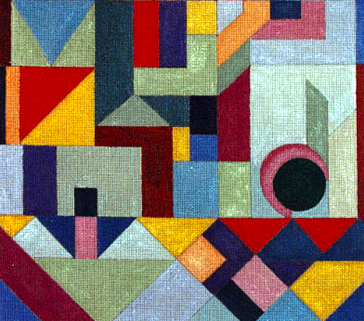
To those less familiar with what needlepoint it is a form of counted thread embroidery in which yarn is stitched through a stiff open weave canvass. The logic as to how this is relevant to sneaker design is simple. By understanding the role and properties that the canvass has in the structuring of the shoe will precipitate the comprehension of both the performance and aesthetic elements of the design.


Traditionally, canvass has been made of cotton, linen or hemp. It is open weave in design. This means that between each of the threads in the weave there is empty space forming a cellular design similar to that of a mesh. It is through this empty space that traditionally a yarn is stitched through to decorate the canvass. As the yarn is stitched through it reinforces the skeletal canvass structure so by increasing its durability and potential to form and hold any shape. Canvasses vary not just in the size of the spaces between each thread but also the number of threads that are woven to form the canvass. The smaller the holes then the stronger the canvass is and the more detailed the decoration can be. The same effects can be achieved by increasing the number of threads in the weave. The downside to these traditionally formed canvasses is that cotton, linen and hemp are all relatively heavy and heavier still once you account for the yarn stitched through for decoration. But this can all be changed.   


The current design trends in athletic footwear dictate that the lighter the shoe the better it is as long as shoe’s level of performance has not been sacrificed. A prime example of this is the Nike Air Roshe. The entirety of its upper, toe box and heel counter is made of a woven synthetic mesh. This mesh is similar in structure to that of a traditional mono canvass. 


Fundamentally, there is no reason as to why it would not be possible to use contemporary synthetic materials to re-invent needlepoint embroidery and make it part of an ever increasing Nike Craft range. Needlepoint should not be defined solely by the traditional materials that formed its earliest of expressions. Rather it should be defined by the actual technique of stitching any fiber through any open weave fabric whether natural or synthetic. As the premise of the craft is to link individual stitches together to from infinite types of shapes, patterns and images, there is no need for the whole shoe to be covered in needlepoint. Needless to say the synthetic mesh is pleasing to the eye in its natural state as the FlyKnit demonstrates.

The real coup de grace of needlepoint is its potential for complexity. Its potential is best compared to that of pixels in digital images. A single stitch equates to the same as a single pixel. The more pixels in a square inch the better the resolution is of the image. The exact same is true for needlepoint. The more holes that there are in a square inch of canvass, the more stitches can be made and the more detailed the image can be. Sadly no one has yet managed to translate this craft onto sneakers. It thus falls down to you to use your imagination to substitute some of the traditional needlepoint designs I have sourced below and re-imagine them on a sneaker. Your task doesn’t just end there. It is also vital that you imagine a variety of different synthetic and natural fibers have been used for the stitches to create the same design but for a different effect.